

Global Geopolitics 2026: How New World Balances Are Reshaping the B2B Haircare Market
By Max Randi (Editor-in-Chief, Il Magazine del Parrucchiere)
If there is one lesson that we beauty professionals have learned over recent years, it is that the destiny of a hair salon is not decided solely within the shop walls or inside formulation laboratories. In our deeply interconnected world of 2026, a diplomatic agreement signed thousands of miles away possesses the direct power to influence the cost of a color tube, the availability of aluminum packaging, or the price of electricity powering our blow dryers.
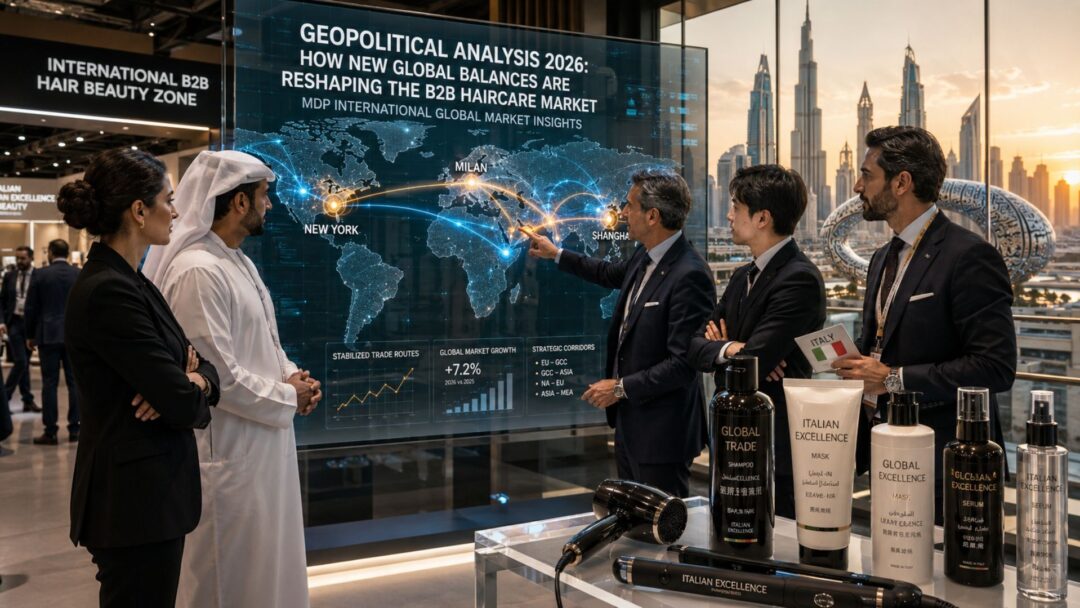
Today, we are witnessing a crucial turning point. The transition from intense international friction to a phase of stabilized, transactional diplomacy—driven by the progressive reopening of major global trade routes—is defining new economic tracks for the professional cosmetics sector and the salon supply chain.
What does this mean concretely for the B2B hair beauty pipeline? Let us analyze the three primary macroeconomic factors that will guide our industry in the coming months.
1. Logistics and Pricelists: The End of Shocks, the Rise of Stability
The progressive securing of global maritime routes and strategic commercial corridors is finally relieving pressure on worldwide logistics. For cosmetics manufacturers, this means an end to sudden, unpredictable spikes in ocean freight rates and raw material procurement bottlenecks, particularly for essential packaging materials like plastics, glass, and aluminum.
However, we must not expect an automatic drop in wholesale prices. Structural inflation and European energy costs remain firmly high. Brand pricelists will not decrease; instead, they will become predictable. For salon owners, the challenge will no longer be chasing the emergency of monthly price hikes, but rather learning to optimize internal margins by implementing scientific inventory control and strict overhead management.
2. The Luxury Route Shifts to Emerging Markets
New geopolitical equilibria and the normalization of economic relationships in strategic areas like the Middle East are catalyzing massive capital flows. The Persian Gulf is rapidly transforming into the new Eldorado for the high-end beauty and wellness market.
Major multinationals and premium Italian brands are reshaping their marketing and distribution budgets to capture this extraordinary international spending power. This phenomenon will indirectly impact the domestic market as well: we will soon see the arrival of highly advanced, technologically superior formulations—originally designed to withstand extreme climates—and an acceleration toward high-value curative and hybrid lines (skincare/haircare blends).
3. Consumption Polarization: Salons Must Choose Their Identity
Rigid national budgets and economic pressure on European consumers are splitting client spending into two distinct paths. Mass-market and mid-range segments are experiencing a contraction in purchasing power, whereas the premium segment and elite professional services continue to post excellent performances. Salon visitors today are not abandoning quality, but they demand an impeccable experience and certified results.
In this economic climate, competing through downward price wars is a failing commercial strategy. Forward-thinking brands and salon owners are forging strategic alliances built entirely on specialization. Cutting-edge technical services, personalized deep-reconstruction treatments, and targeted home-care retail represent the only real levers available to secure revenue and boost the profitability of every single client visit.
The Role of B2B Information in a Changing Market
In a commercial landscape that no longer tolerates approximation, the role of an information hub like Il Magazine del Parrucchiere must evolve. Hairdressers and cosmetic companies are no longer just looking for fashion trends or artistic inspiration for its own sake; the real necessity today is access to real data, applied business strategies, technical benchmarks, and transparent market forecasting.
The global economic stability currently taking shape offers immense growth opportunities for those who can govern change using sharp managerial skills. The future of our industry belongs to those who stop reacting to the market and begin, data in hand, to plan it.