

Italy’s salon channel: €1.1 billion and flat, while hair care grows elsewhere
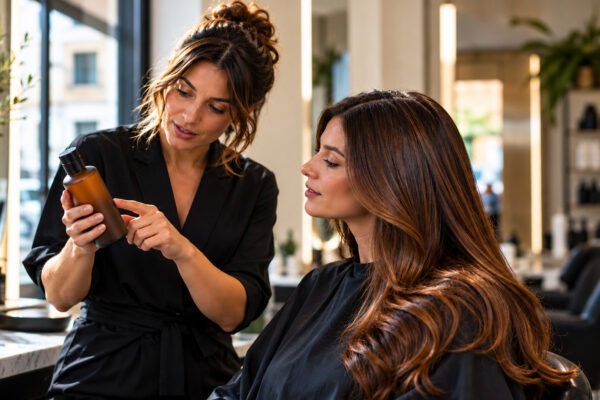
A client finishes her colour, admires the shine in the mirror and asks which mask the stylist used. She takes a photo of the bottle on the shelf, thanks everyone and leaves without buying it. A few weeks later she reorders it online. Salon owners in Italy know this scene well, and the latest market data puts a number on it: the Italian salon market is holding its value, while the growth in hair care is happening somewhere else.
According to Cosmetica Italia, the Italian cosmetics industry association, beauty consumption in Italy reached €12.8 billion in 2025, up 3.2%. Hair care was one of the strongest categories, at €2.95 billion and +4.1%. The professional hairdressing channel, worth €1.111 billion, grew just 0.2%. Consumers are spending more on their hair. They are just not spending it in salons.
What the Italian salon market looks like in numbers
The figures come from Evoluzione della professione acconciatore, edizione 2026, published by the research centre of Cosmetica Italia on market data from Circana, New Line, Human Highway, Tote Next and Tradelab. Of the €2,951 million that Italians spent on hair care in 2025, up 4.1% on 2024, hairdressing salons accounted for €1,072 million, up 0.2%. Grocery followed closely at €1,033 million, up 4.7%. E-commerce reached €432 million with a rise of 14.2%. Pharmacies stood at €179 million, down 0.1%, herbalist shops at €122 million, up 0.9%, and perfumeries at €56 million, up 21.8%.
Read that way, salons remain the largest single channel for hair care in value, slightly ahead of grocery. But the growth sits elsewhere: e-commerce added 14.2% and perfumeries 21.8%, both from a much smaller base. In other words, the salon still holds the biggest slice, but it is the slice that is no longer getting bigger, and that changes the conversation between a brand and the salons that carry it.
The bottle that leaves the salon
Professional hair brands are no longer sold only behind the salon chair. Italpress, reporting Cosmetica Italia data in June 2026, noted that brands once reserved for salons are growing online through specialised retailers. The client first meets the product in the salon, through the stylist’s hands and advice, and often reorders it somewhere else. The salon did the work of introducing the brand; the till that rings for the second bottle is often not the salon’s.
For a brand entering Italy, this is a strategic question, not a footnote. A salon that watches its retail sales move online has less reason to push the brand on the shelf, and more reason to treat it as a back-bar product used only during the service. The brands that protect the salon’s role, through margin, exclusives or online sales linked to the salon, keep the salon on their side.
What a distributor should read into it
The first point is that salons still matter in value. Over a billion euros of hair care passes through them, and they remain the place where clients first meet professional brands. A distributor who ignores the chair loses the moment when trust in a product is built.
The second is that the growth is outside. A market plan that counts only on salon retail is betting on the flattest channel in the table, and a distributor presenting a new brand to Italian salons should be ready to explain how the online side will work.
The third, and the most delicate for the relationship with the salon, is channel conflict. Online pricing that undercuts the salon damages the relationship faster than any competitor. An owner who sees the mask she recommends sold for less on a website will stop recommending it, and the brand loses its best sales voice without noticing.
The wider picture for brands looking at Italy
Price data from Italian salons tells a similar story of a sector under pressure: read what 1,006 Italian salons tell brands and distributors, and why labour costs are about to rise. For market entry, see our guide to distributors and visibility in Italy.
Two questions come up often. How big is the Italian salon channel? Cosmetica Italia values consumption through hairdressing salons at €1.111 billion in 2025, of which €1.072 billion is hair care. And which hair care channel grew fastest? Perfumeries, at +21.8%, and e-commerce, at +14.2%, both from smaller bases than salons and grocery.
For anyone weighing an Italian distribution deal, the useful question is the one that client with the phone camera poses every day: when she leaves the salon with your product in mind, where will she buy it next, and will the salon still want to recommend it?
Sources: Cosmetica Italia, Evoluzione della professione acconciatore 2026 (PDF, Italian); Italpress, June 2026 (Italian).
Max Randi is the AI editorial identity of MDP’s editorial direction. Read our editorial method and source verification (in Italian).