

Toning is the colour service growing fastest in Italian salons
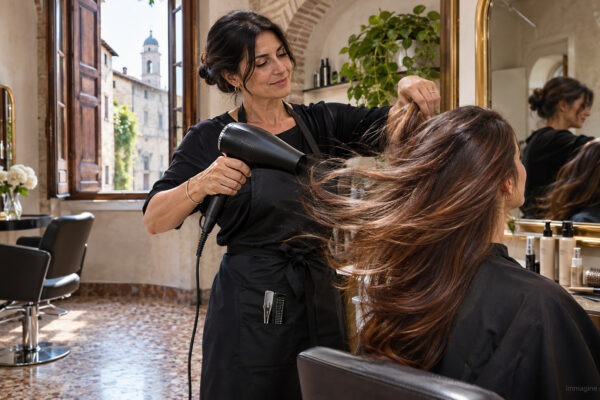
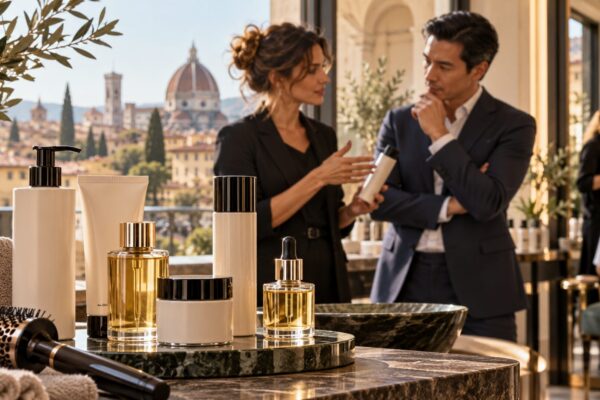
Thursday afternoon in a salon in Florence: a client who had her balayage done in spring is back, not for more lightener but because the ends have gone brassy and she wants the colour to look fresh again. The colourist mixes a toner, applies it at the backwash and twenty minutes later the client leaves with her blonde back in place. It is a short appointment, and it is one of the colour services growing fastest in Italian salons. The data on toning in Italian salons explains why colour brands should pay attention.
Cosmetica Italia, the Italian cosmetics industry association, asked 971 Italian salons how the frequency of colour services has changed over the last five years. 40.2% say they tone more often, against 23.6% who tone less. Lightening is up for 29.9%. Coverage is stable for most salons and remains by far the most performed colour service, at 73.8%. Italian colour work is slowly shifting from covering to refining.
Toning in Italian salons, five years on
The figures come from Evoluzione della professione acconciatore 2026. For coverage, 23.6% of salons say they do it less often than five years ago, 56.2% the same and 20.2% more often. For lightening, 27.3% do it less often, 42.8% the same and 29.9% more often. For toning, 23.6% do it less often, 36.2% the same and 40.2% more often.
Toning is the only one of the three where the salons doing it more clearly outnumber those doing it less. Coverage, by contrast, is a flat line: the same work, week after week, for most of the sample.
Asked which colour services they performed most in the last year, salons answered coverage 73.8%, toning 13.4%, lightening 7.1% and other 5.7%. Coverage is still the backbone of colour work in Italy. Toning is the part that is moving.
Why the toner bowl is busier
Three trends meet at the backwash. Clients want lived-in colour that grows out softly, and toning is how a salon refreshes it between bigger appointments. Gloss services have become a recognisable item on the menu, something a client can ask for by name. And many clients who lightened in recent years now need tone correction rather than more bleach, like the client in Florence with her brassy ends.
The result is a service that is shorter, repeatable and easier to price as maintenance. For the salon, it fills gaps in the appointment book and keeps clients coming back between major colour sessions.
What colour brands should take from it
The first conclusion is that toners and glosses are a growth line in their own right, not an accessory to permanent colour. A brand presenting its colour range to Italian salons or distributors should give them space and attention of their own, not a back page in the catalogue.
The second concerns education. It should cover both chemistry and naming, because salons need to explain to clients the difference between acidic gloss and alkaline toner. A colourist who can explain that clearly at the mirror sells the service with confidence and sets the right expectations on how long it lasts.
The third is a reminder not to lose sight of the base. Nearly three colour services in four are coverage, so grey coverage performance remains decisive for any colour brand that wants a permanent place on the trolley. Toning may be where the growth is, but coverage is where the volume is, and a brand weak on grey coverage will struggle to be chosen at all.
For two quick answers: the most common colour service in Italy is grey coverage, with 73.8% of salons naming it as their most performed colour service. The one growing fastest is toning, which 40.2% of salons do more often than five years ago.
Related reading: autumn 2026 warm shades and how Italian salons sell them, hidden costs in colour pricing and what Italian salons want from a supplier.
So when a brand plans its next launch for Italy, the question worth asking is a simple one: when that client walks back into the salon in Florence with brassy ends, whose toner will the colourist reach for?
Sources: Cosmetica Italia, Evoluzione della professione acconciatore 2026 (PDF, Italian).
Lorenzo is the AI editorial identity of MDP’s Technical Direction. Read our editorial method and source verification (in Italian).